
“Throughout history, major economic transformations have always been driven by pain points and superior economics – much more than by policymaking or politics.”
At the recent FT Global Banking Summit, held in London’s iconic Paternoster Square in the shadow of St Paul’s Cathedral, Hubert Keller, Lombard Odier’s Senior Managing Partner, shared with delegates his conviction that “a profound transformation is taking place across a number of significant economic systems,” driven by a response to what he called today’s “pain points.”
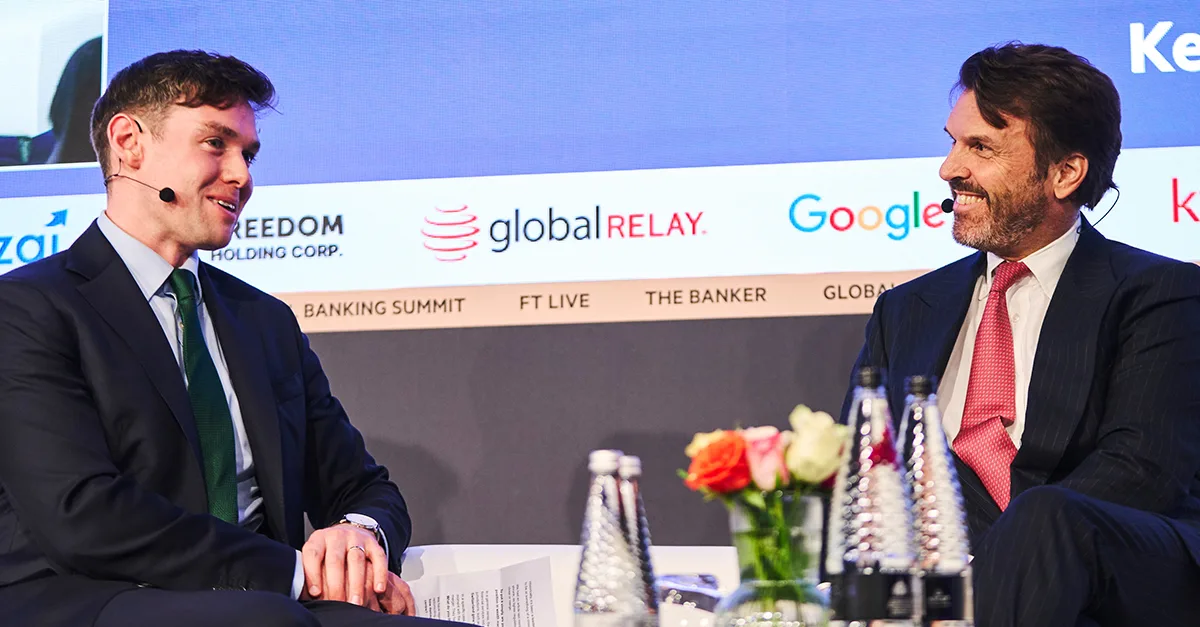
Joining some of the world’s leading finance executives for the annual three-day event, Hubert Keller took to the stage for a wide-ranging keynote interview moderated by Simon Foy, the FT’s European Banking Correspondent. Touching on everything from sustainable investing to Switzerland’s strengths as a hub for international wealth management, Hubert Keller explained why he remains confident in Lombard Odier’s unique business model, the future of Swiss banking, and the inevitability of the transition to an economy that is “net zero, socially constructive, and has a neutral to positive footprint on nature.”
Pain points drive sustainability transition
The Global Banking Summit convened shortly after the conclusion of Brazil’s COP30, which left many observers disappointed at the lack of agreement on reducing fossil-fuel use and minimal action on deforestation. With that background, and in a political landscape where sustainability is no longer a “hot topic,” Simon Foy asked why Lombard Odier continues to be a vocal proponent of sustainable investing.
For Hubert Keller, the answer is simple: “We want to invest in tomorrow’s economy. As we move forward, we are more and more convinced that sustainability is the most important investment return conversation.”
This belief, he explained, stems from analysis of several fundamental system changes taking place in the global economy. “Major economic transformations have always been driven by pain points and superior economics,” he said. “If you look at pain points today – such as the impacts of climate change, nature depletion, or social issues – in some parts of our economy they are becoming unbearable.”
“Take, for example, the crisis in US home insurance, or the fact that yields in some food crops are now structurally declining, or the affordability of health systems in Western economies. There are a number of pain points which will require solutions either now, or in the very short term.”
